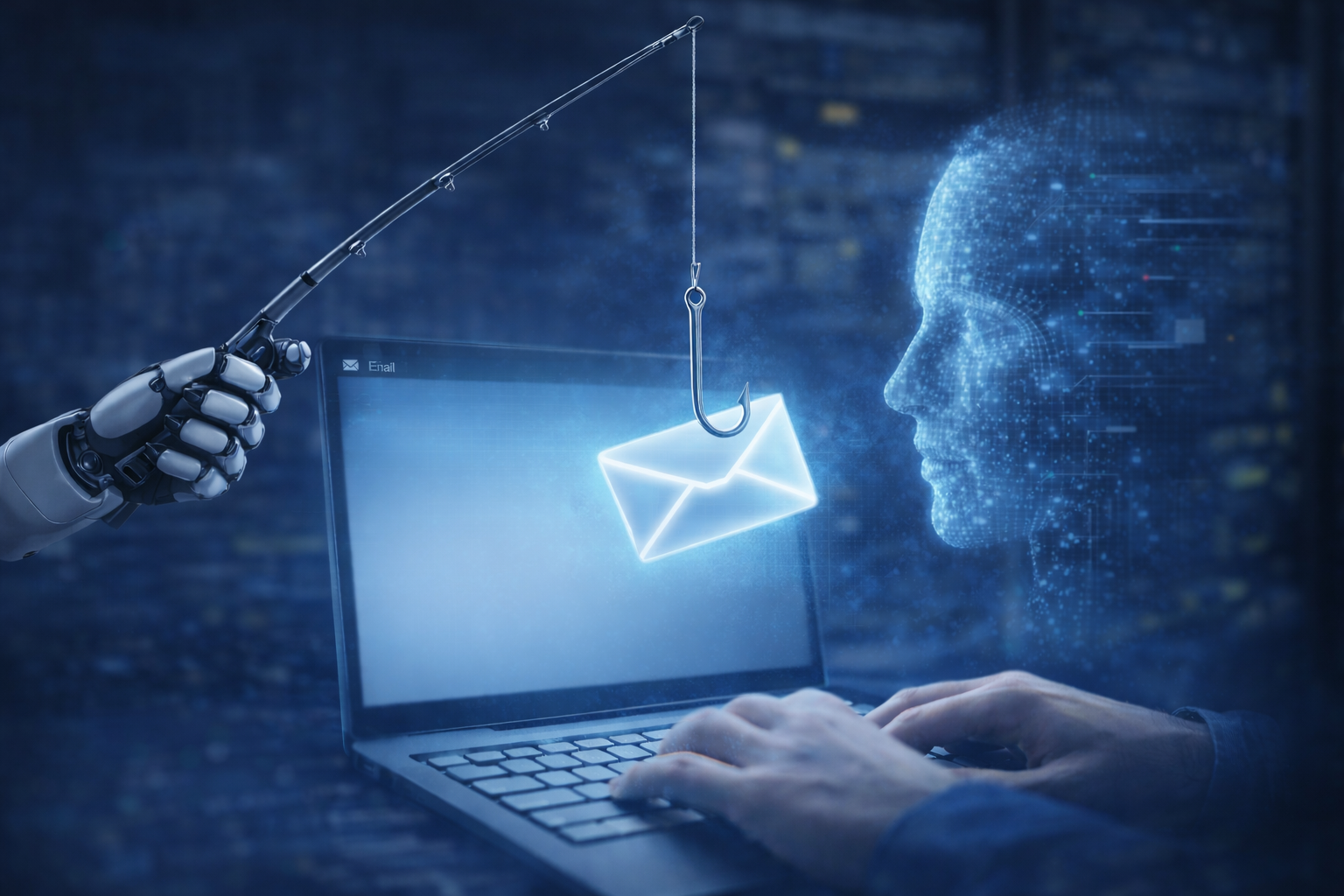
The phishing emails your employee almost clicked on last Tuesday looked nothing like the ones from five years ago. No broken English, no suspicious links hidden in obvious places, no generic greeting. It used your company name, referenced a real vendor relationship, and was written better than most internal memos. That is not a coincidence. That is AI, and it is being used against small businesses at a scale and sophistication level that most owners are completely unprepared for. AI generated phishing emails are no longer a future threat. They are what is hitting inboxes in Illinois right now, every single day.
Why AI Generated Phishing Emails Are a Different Problem Than What You Faced Before
For years, phishing emails were relatively easy to spot if you knew what to look for. Odd formatting, urgent requests that made no business sense, email addresses that were one letter off from the real thing. Security awareness training built around those signals worked reasonably well because the attacks themselves were blunt instruments.
Phishing-related breaches now average $4.88 million per incident according to IBM’s 2024 report. IBM researchers also demonstrated that AI built a phishing campaign in 5 minutes using 5 prompts — a task that took human experts 16 hours.
What makes this particularly difficult for small businesses is that the AI doing the writing has often already done its homework. Attackers use publicly available information, LinkedIn profiles, company websites, press releases, and even social media posts to personalize attacks before the email is ever generated. A non-profit director in Chicago receives an email that references a recent grant announcement. A manufacturing plant manager in the suburbs gets a message that appears to come from their ERP software vendor with a plausible reason to click. The context is real. Only the sender is not.
The numbers behind the problem:
- A cyberattack hits a small business every 11 seconds according to Cybersecurity Ventures.
- 91 percent of all cyberattacks begin with a phishing email according to Deloitte.
- AI-crafted phishing emails have a click-through rate of 54 percent compared to 12 percent for traditional phishing according to IBM X-Force.
- The average cost of a successful phishing attack on a business under 500 employees reached $4.91 million in 2024 according to IBM’s Cost of a Data Breach Report.
That last number deserves to sit with you for a moment. A single successful phishing email, one employee click, can cost a small business nearly five million dollars when you factor in breach response, regulatory penalties, reputational damage, and operational disruption.
Why Do Phishing Emails Generated by AI Seem So Real
This is the question we hear most often from business owners after a near miss, and it deserves a straight answer.
Traditional phishing was mass-produced and impersonal. AI phishing is neither. Modern attack tools can pull your company’s name, your leadership team, your recent news, your vendor relationships, and even the tone and writing style of your existing communications before generating a single email. The result is a message that does not just look real. It feels real because it contains real information about your business written in a way that matches how your industry actually communicates.
There is also a technical dimension to this. AI-generated emails are specifically engineered to evade the signature-based detection methods that most legacy email security tools rely on. If your email filtering is looking for known bad phrases, blacklisted domains, or suspicious link patterns, it is looking for the wrong things. AI phishing does not follow the old playbook.
Your employees are not failing security awareness training. They are up against tools that are specifically designed to fool people who are paying attention.
According to a 2024 study by Hoxhunt, even security-trained employees fail to identify AI-generated phishing emails 34 percent of the time. In a company of 50 people, that means roughly 17 employees will click on a well-crafted AI phishing email even after completing awareness training. The human layer alone is no longer a sufficient defense.
A Scenario Your Team Will Recognize
A financial services firm in the Chicago metro area received what appeared to be a routine email from their cloud storage provider. The message referenced a real upcoming contract renewal, used the correct account number, addressed the office manager by her first name, and included a link to review updated terms before the renewal deadline.
The email was AI-generated. The link installed credential-harvesting malware that sat undetected on the network for 67 days before the firm’s IT provider identified unusual outbound traffic. During those 67 days, client financial records were accessible to the attacker.
The firm had completed phishing awareness training six months earlier. They had a firewall. They had antivirus software. What they did not have was real-time detection of AI phishing emails at the email gateway level, behavioral monitoring on their network, or a security stack that was designed for the way attacks actually work in 2025.
This is not an unusual story. It is an increasingly common one, and it plays out in manufacturing plants, non-profit offices, and professional services firms across Illinois every month.
How to Identify AI Generated Phishing Emails and What Your Business Can Do About It
Knowing that the threat has evolved is useful. Knowing what to do about it is what actually protects your business. Here is where to focus.
Move Beyond Awareness Training Alone
Training still matters but it cannot be your primary defense. Your employees should know to pause before clicking, to verify unusual requests through a second channel, and to report suspicious emails rather than deleting them quietly. But given that trained employees still fail to identify AI phishing 34 percent of the time, training has to be backed by technical controls that do not depend on human judgment in the moment.
Implement AI Email Filtering for Phishing Prevention
The most effective response to AI-generated attacks is AI-powered defense. Modern email security platforms including Microsoft Defender for Office 365, Proofpoint, and Mimecast use behavioral analysis and machine learning to detect phishing patterns that signature-based tools miss entirely. They are looking at how an email behaves, not just what it contains. This is the category of tooling that BSGtech deploys as part of its Cybersecurity services for Illinois SMBs.
Add Multi-Factor Authentication Everywhere
If a credential is compromised through a phishing attack, MFA is the last line of defense that prevents that credential from being used to access your systems. According to Microsoft, MFA blocks 99.9 percent of automated account compromise attacks. It is the single most impactful technical control available to a small business and it is still not universally deployed across the SMB market in Illinois.
Know What a Compromised Account Looks Like Before It Is Too Late
Real-time detection of AI phishing emails at the gateway is essential, but so is behavioral monitoring on your network after the fact. If an employee credential is compromised, behavioral analytics tools will identify unusual login times, unusual file access patterns, and unusual outbound traffic before the attacker has had 67 days to work. This is the difference between catching a breach in hours and discovering it in months.
BSGtech’s Managed IT and Unified Protection programs include continuous monitoring specifically designed to catch post-compromise activity that endpoint tools alone will miss.
Frequently Asked Questions
How to identify AI generated phishing emails?
Look for emails that are unusually personalized, reference specific internal details like vendor names, account numbers, or recent company events, and create a sense of urgency around a financial or access-related action. At the technical level, check the email header for domain mismatches and verify any unusual request through a second communication channel before acting. When in doubt, report it to your IT provider rather than deleting it.
Why do phishing emails generated by AI seem so real?
AI tools can pull publicly available information about your company, your team, and your vendor relationships before generating a personalized email in seconds. The result reads naturally, references real context, and is written without the grammatical errors that made older phishing easy to spot. They are also specifically engineered to bypass the pattern-matching that traditional email filters rely on.
How to identify AI generated phishing emails before employees click?
The most reliable protection is a layered security approach. AI-powered email filtering at the gateway catches threats before they reach the inbox. Security awareness training helps employees recognize behavioral red flags. MFA ensures that even a compromised credential cannot be used to access your systems. No single control is sufficient on its own.
Can AI detect phishing emails on my behalf?
Yes. Modern email security platforms use machine learning and behavioral analysis to identify AI-generated phishing attempts that traditional signature-based tools miss. These platforms analyze sending patterns, content behavior, and contextual signals rather than looking for known bad phrases or blacklisted domains. BSGtech deploys and manages these tools as part of its cybersecurity services for SMBs in Illinois.
Your Next Step
If your current email security was built for the phishing attacks of five years ago, it is not built for what is hitting your inbox today. Contact BSGtech for a cybersecurity consultation and find out exactly where your current defenses have gaps before an AI-generated email finds them first.
