That’s the whole problem in one line. Most maintenance decisions get made on two numbers that were never comparable.
This guide gives you one framework for both models. You’ll see what in-house maintenance actually costs once benefits, tooling, and turnover are counted. You’ll see what a managed contract includes and what it leaves out. Then you’ll calculate your own three-year total cost of ownership for direct versus managed vendor maintenance services, including the hybrid option in between.
What Is Total Cost of Ownership?
What is total cost of ownership in IT procurement? Total cost of ownership (TCO) measures the full cost of owning and maintaining IT assets or services, not just the purchase price or monthly fee. It can include employee salaries and benefits, software and tooling, maintenance, training, downtime, vendor fees, security, and other operating costs across the asset or service lifecycle.
TCO Beyond Purchase Price
The purchase price is the smallest part of what a device costs you.
A laptop has a price tag. It also has imaging and deployment time, a monitoring agent, a share of the help desk, a warranty, repairs after the warranty ends, the productivity lost when it fails, and the labor to wipe and retire it.
The same is true of a service contract. The invoice is visible. What stays on your plate is not.
TCO counts all of it. That’s the only way two options become comparable.
Why Build vs. Buy Is Not Enough
Build versus buy sounds like the right question. It leads people to the wrong comparison.
The usual version puts one IT salary next to one managed services quote. The salary looks smaller. The decision gets made.
That comparison misses three things. The salary isn’t the employee’s full cost. The in-house model still needs tools the vendor would have supplied. And one person can’t cover nights, weekends, vacations, and their own resignation.
Ask a better question: what does each model cost to deliver the same scope of work, over the same period, at the same service level?
What IT Maintenance TCO Includes
What should be included in an IT maintenance TCO? An IT maintenance TCO should include fully burdened employee costs, recruitment and training, monitoring and help desk tools, break/fix labor, vendor fees, warranty administration, after-hours coverage, downtime, security and compliance costs, and leadership opportunity costs. Comparing only salary against a managed services invoice can produce a misleading result.
Group them into four buckets and nothing gets lost:
| Bucket | What goes in it |
|---|---|
| People | Salary, benefits, payroll taxes, recruitment, training, turnover |
| Tools | RMM, ticketing, antivirus and EDR, backup, patching, documentation |
| Operations | Break/fix labor, warranty administration, vendor management, after-hours coverage |
| Risk | Downtime, security incidents, compliance gaps, knowledge concentration |
The Cost of In-House IT Maintenance
In-house maintenance means you employ the people and own the tools. The costs are real but scattered across departments, which is why they’re easy to undercount.
Salary and Employee Costs
Start with fully burdened cost, not salary.
Burden covers payroll taxes, health insurance, retirement contributions, paid time off, equipment, and workspace. A common planning rule is to multiply base salary by 1.25 to 1.4 to estimate it.
Illustrative assumption: a $75,000 IT administrator costs roughly $94,000 to $105,000 fully burdened. Replace both numbers with your own payroll and benefits data.
One more line people forget: the manager’s time. Someone hires, supervises, and reviews this person.
Recruitment and Training Costs
Hiring is a cost even when it goes well.
Count the job posting, recruiter fees if you use one, the interview hours across your team, and the ramp-up period before a new hire is productive. Then count certifications and continuing education, since IT skills go stale fast.
Turnover repeats every one of those costs. Model it: if the role turns over once in five years, spread that cost across the five-year plan rather than pretending it won’t happen.
IT Tools and Software Costs
In-house teams buy the tools a managed provider already owns.
A working stack usually includes remote monitoring and management, a ticketing system, endpoint detection and response, backup and recovery, patch management, and documentation. Most are priced per endpoint per month, so the cost scales with headcount.
Managed providers spread these licenses across their whole client base. A 30-person company buying the same stack alone pays more per seat. Price your specific stack and put the real number in the model.
Break/Fix and Downtime Costs
Break/fix is the unpredictable part of the budget.
Out-of-warranty repairs, emergency parts, and specialist callouts arrive without notice. So does the labor to handle them.
Downtime is the bigger line, and most organizations never price it. A workable method: multiply the number of affected employees by their loaded hourly cost by the hours lost, then add any revenue that didn’t get earned during the outage. Run it for a realistic number of incidents per year.
That calculation is what turns downtime from an annoyance into a budget line you can compare. The hidden cost of outdated IT walks through what those incidents look like on the ground.
The Cost of Managed IT Services
A managed contract converts most of those scattered costs into one predictable fee. It does not convert all of them, and the gap is where budgets break.
What the Monthly Fee Includes
Most managed agreements are priced per user or per device, per month.
A typical scope covers monitoring, help desk support, patch management, endpoint security, backup management, and vendor coordination. The provider’s tool stack comes with it, which removes a line from your own budget.
What you’re buying is coverage and capacity. A team absorbs vacations, sick days, and resignations without a gap. Our breakdown of managed IT services costs covers how pricing models differ.
What Managed Services Exclude
Exclusions are where a clean comparison goes wrong. Read the agreement for these:
- Hardware itself. Devices, servers, and network gear are almost always separate.
- Project work. Migrations, office moves, and rollouts are usually quoted per project.
- Third-party licensing. Microsoft 365, line-of-business apps, and specialty software.
- On-site visits. Often capped, or billed beyond a set number.
- After-hours work. Sometimes included, sometimes a premium rate. Check.
- Your internal time. Someone still owns the vendor relationship and approves work.
Any excluded item stays in your TCO. Move it to the in-house column of the model, not out of the model.
OEM vs. Third-Party Maintenance
Hardware maintenance is a separate decision from IT support.
OEM maintenance comes from the manufacturer. You get certified parts, firmware access, and the original warranty path, at a higher price. It’s the right call for equipment under active support and for anything with compliance implications.
Third-party maintenance providers service hardware after the OEM warranty ends, often at a significant discount, and will support gear the manufacturer has declared end of life. The tradeoffs are parts sourcing and firmware access.
Many organizations run both: OEM coverage on newer production systems, third-party on aging equipment they plan to retire anyway.
Hidden Costs of IT Maintenance
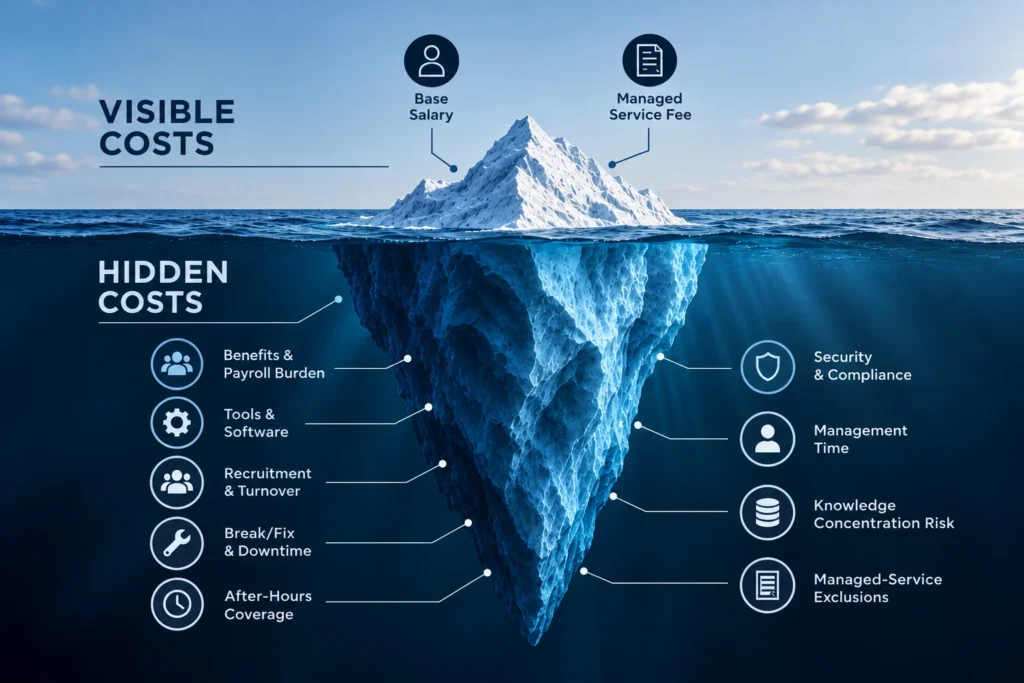
These are the costs that don’t show up on either the payroll report or the vendor invoice. They’re also the ones that decide which model is actually cheaper.
Knowledge Concentration Risk
When one or two people hold everything, you have a single point of failure.
The passwords, the network diagram, the reason that server has a strange configuration: if it lives in someone’s head, it leaves when they do. Recovery means paying someone to rediscover your own environment.
Price it honestly. Estimate the weeks of reduced capability after a key departure, plus the consulting hours to document what was lost. Documentation standards and shared access reduce this cost in either model.
Recruitment and Turnover
IT turnover costs more than the recruiting fee.
There’s the vacancy period, when work queues up or goes undone. There’s the overtime or contractor coverage during the gap. There’s onboarding time from your other staff, and the months before the new hire is fully productive.
A reasonable planning assumption is one turnover event per role across a five-year window. If your model assumes zero, it isn’t a model.
After-Hours Coverage
A single IT employee covers roughly 40 hours a week. Your business runs 168.
Covering the rest costs something in every model: on-call stipends, overtime, a second hire, or a vendor contract. Skipping the coverage has a cost too, paid in longer outages when something breaks on a Friday night.
Decide what coverage you actually need before you price anything. Manufacturing with a second shift needs more than a nine-to-five office.
Security and Compliance
Security work is a cost line in both models, and it’s rarely optional.
Count endpoint protection, monitoring, patching discipline, backup testing, security awareness training, and incident response readiness. Regulated organizations add audit preparation, evidence collection, and framework-specific controls. Our overview of IT compliance services covers what HIPAA, PCI DSS, and CMMC require.
The cost of a breach belongs here too, weighted by likelihood. That’s uncomfortable to estimate, and leaving it out quietly assumes it’s zero. Cybersecurity for small businesses sets out the baseline controls most organizations need.
IT Leadership Opportunity Cost
Someone senior manages IT, whichever model you pick.
In-house, that’s hiring, supervising, escalations, and vendor calls. Managed, it’s contract oversight and approvals, which is a much smaller load but not zero.
Price the difference in hours at that person’s loaded rate. When a director spends ten hours a week on IT management, that’s a quarter of a senior salary spent on work they weren’t hired to do.
In-House vs. Managed IT Costs
Is managed IT cheaper than in-house IT? Not always. Managed IT can reduce the cost of dedicated staffing, tooling, after-hours coverage, and specialized expertise, while in-house IT may be more economical when an organization already has sufficient staff and infrastructure. A fair comparison requires fully burdened in-house costs, managed service fees, excluded services, downtime, and other hidden costs.
Side-by-Side TCO Comparison
| Cost category | In-house | Managed vendor |
|---|---|---|
| Core labor | Fully burdened salaries | Included in monthly fee |
| Recruitment and turnover | Yours | Provider’s |
| Tool stack | You license it | Included in most agreements |
| After-hours coverage | On-call, overtime, or a gap | Per the service agreement |
| Hardware purchases | Yours | Yours, almost always excluded |
| Project work | Staff time, if capacity allows | Usually quoted separately |
| Specialized expertise | Hire or contract as needed | Access to a bench |
| Vendor management | Yours | Usually the provider’s |
| Knowledge risk | Concentrated in your staff | Spread across a team |
| Cost predictability | Variable | Largely fixed |
Which Costs Are Often Overlooked?
Five lines get missed more than any others. Check your model for each:
- Benefits and payroll burden. Salary alone understates labor by 25 to 40 percent.
- The tool stack. Easy to miss because it’s spread across several vendors and renewal dates.
- Downtime. Usually absent entirely, and often the largest number in the model.
- Turnover. Modeling zero turnover over five years is wishful thinking.
- Excluded services. Anything the vendor doesn’t cover comes back to you at full cost.
The Hybrid IT Maintenance Model
The choice isn’t binary. Most mid-sized organizations end up somewhere in the middle, and often deliberately.
How Co-Managed IT Works
In a co-managed arrangement, your internal staff and a provider split the work along agreed lines.
A common split: your team handles user support, business applications, and anything requiring institutional knowledge. The provider handles monitoring, patching, security operations, after-hours escalation, and specialist projects.
Our co-managed IT services page covers how the division of labor gets defined. IT staff augmentation vs. managed services explains how it differs from simply renting extra hands.
Hybrid Cost Structure
Hybrid costs sit between the two models, but not at the midpoint.
You keep some burdened labor, and you add a vendor fee that’s smaller than full managed coverage. In exchange, you drop most of the tool stack, the after-hours burden, and the knowledge concentration risk.
Model it as a real third column. Splitting the difference between your other two columns will give you the wrong answer.
When Hybrid Makes Sense
Hybrid tends to win in four situations:
- You already employ capable IT staff you don’t want to lose
- Your team is strong on daily support but thin on security or compliance
- You need coverage outside business hours without hiring a second shift
- You’re growing fast and want to scale support without a hiring cycle for every step
Choosing the Right Maintenance Model
The numbers narrow the field. These four factors usually decide it.
Company Size and IT Staffing
Headcount is the strongest single predictor.
Under about 25 employees, a full-time IT hire is hard to justify, and managed coverage usually wins. Between 25 and 100, it’s genuinely close, and the hidden costs decide it. Above 100, most organizations need internal staff for daily support, which makes hybrid the common landing spot.
These are starting points, not rules. A 40-person engineering firm has more IT need than a 200-person warehouse operation. Our guide to IT services for small businesses covers the smaller end in detail.
Risk and Downtime
Ask what an hour of downtime costs you. The answer reshapes the whole comparison.
A law firm can absorb a slow morning. A manufacturer with a stopped line cannot, which is why IT support for manufacturers is built around uptime. A financial services firm faces client obligations and regulatory exposure the moment systems go down. See IT support for financial services for how that changes requirements.
High downtime cost justifies redundant coverage. Low downtime cost means you can accept a slower response and spend the savings elsewhere.
Skills, Compliance, and Growth
Breadth of need matters as much as volume.
One generalist can cover ordinary support. Few generalists also cover security operations, cloud architecture, compliance evidence, and network engineering. Hiring for all of it means several salaries.
Growth changes the math too. Adding 20 employees to a managed agreement is a line-item change. Adding them to a one-person IT team is a hiring cycle.
If you’re regulated, weigh who can produce audit evidence on demand. That capability is expensive to build and routine for a provider who does it across many clients.
In-House vs. Managed vs. Hybrid
| Your situation | Likely best fit |
|---|---|
| Under 25 employees, no IT staff | Managed |
| 25 to 100, no IT staff, standard needs | Managed |
| 25 to 100, one IT employee already | Hybrid |
| Over 100, existing IT team | Hybrid, or in-house with specialist support |
| High compliance burden, small team | Managed or hybrid |
| Highly specialized in-house systems | In-house with vendor backup |
| Unpredictable growth | Managed or hybrid |
Our guide to choosing a managed IT services provider covers what to ask once you’ve picked a direction.
How to Calculate IT TCO
Six steps. Use the same scope, the same period, and the same assumptions across every model you’re comparing.
Step 1: Define the Maintenance Scope
Write down exactly what’s being covered before you price anything.
List the endpoints, servers, and network devices. Name the applications you support. State your hours of coverage and your target response times. Note any compliance requirements.
This list is the control for the whole exercise. If one model covers less than another, you’re comparing two different things.
Step 2: Calculate In-House Costs
Build the annual in-house number from these lines:
Management time at the loaded rate of whoever oversees IT
- Fully burdened salaries for every person doing this work, including partial allocations
- Recruitment and training, with turnover spread across the period
- Tool and software licensing, priced per endpoint
- Break/fix labor, parts, and out-of-warranty repairs
- After-hours coverage, whether that’s on-call pay, overtime, or a contract
- Downtime, using your own incident history
Step 3: Calculate Managed Costs
Start with the annual contract value, then add everything the contract excludes.
That means hardware, third-party licensing, project work quoted separately, on-site visits beyond the included allowance, and any internal time spent managing the relationship. Add downtime here too, adjusted for the provider’s response commitments.
A managed model with exclusions priced honestly is still usually simpler to forecast. That’s part of its value.
Step 4: Calculate Hybrid Costs
Split the scope from Step 1 between your team and the provider, then price each side with the methods above.
Watch for double counting. If the provider supplies the tool stack, remove those licenses from your internal column. If your staff keep handling user support, don’t pay for it twice.
Step 5: Project 3 to 5 Years
One year hides the pattern. Three to five years shows it.
Apply the same growth assumptions to every model: headcount change, salary increases, contract escalators, and hardware refresh cycles. Put the turnover event in the in-house column where you expect it.
Use consistent periods. Comparing a three-year vendor contract against one year of salary is the same mistake in a different form.
Step 6: Test Your Assumptions
Run the model twice more, once optimistic and once pessimistic.
Move the variables that matter most: downtime hours, turnover, growth rate, and the number of break/fix incidents. If a small change in one assumption flips the answer, you’ve found the number that deserves real research before you decide.
Document every assumption next to the result. A model nobody can audit won’t survive a conversation with finance.
Hidden Cost Self-Assessment
Use this before you finalize any model. Each unchecked box is a cost you probably haven’t counted.
IT Maintenance Cost Checklist
How to Interpret Your Results
Count your unchecked boxes.
Nine or more checked: your model is solid. Compare the totals and decide.
Five to eight checked: the shape is right, but the gaps are usually the expensive lines. Fill them before presenting to finance.
Under five checked: you’re comparing a salary to an invoice. That’s the comparison this guide exists to replace.
Watch for a specific failure: if the models come out within about 10 percent of each other, the decision isn’t about cost at all. Pick on coverage, risk, and capability instead.
3-Year TCO Example
Here’s the framework applied to one company. Every figure below is an illustrative assumption chosen to show the method. Swap in your own numbers before drawing conclusions.
Scenario and Assumptions
The company: 60 employees, 75 endpoints, three servers, two locations, no compliance framework beyond standard cyber insurance requirements. Coverage needed from 7am to 6pm, with after-hours escalation.
Stated assumptions:
- One IT administrator at $75,000 base, with a 1.3 burden multiplier
- One turnover event during the three years
- Tool stack priced per endpoint, per month
- Downtime valued at employee loaded cost multiplied by hours lost
- Managed pricing modeled per user, per month
- No inflation or headcount growth, to keep the comparison readable
Those last two are simplifications. A real model should include both.
Three-Year Cost Comparison
| Cost line | In-house | Managed | Hybrid |
|---|---|---|---|
| Burdened IT labor | $292,500 | $0 | $292,500 |
| Recruitment and turnover | $25,000 | $0 | $25,000 |
| Tool stack | $54,000 | Included | Included |
| Vendor fees | $0 | $216,000 | $108,000 |
| Break/fix and parts | $18,000 | $6,000 | $6,000 |
| After-hours coverage | $21,000 | Included | Included |
| Downtime | $45,000 | $18,000 | $18,000 |
| Management time | $27,000 | $9,000 | $13,500 |
| Three-year total | $482,500 | $249,000 | $463,000 |
Key Takeaways
Four things this example demonstrates about the method, not about your business:
Labor dominates. Burdened salary is roughly 60 percent of the in-house total. Get that number right before you refine anything else.
Hidden costs move the result. Turnover, after-hours coverage, downtime, and management time add $118,000 to the in-house column. Leave them out and the two models look far closer than they are.
Hybrid costs more than managed here, and that can still be correct. This company keeps its IT administrator. If that person holds critical institutional knowledge or supports a specialized system, the premium buys something real.
The answer changes with scale. Push headcount to 150 and the in-house column improves, because one salary now covers more users while managed fees rise per seat. Run your own numbers at your own size.
Common TCO Misconceptions
Four beliefs distort more IT maintenance decisions than any others.
Managed Services Are Always Cheaper
They aren’t. Managed services spread staffing, tooling, and coverage across many clients, which usually helps smaller organizations most.
Organizations that already employ capable IT staff and own their tool stack sometimes find in-house is cheaper for their core work, with a provider filling specific gaps. The answer depends on your size, your scope, and your risk tolerance.
In-House Means More Control
In-house gives you direct authority over priorities. It doesn’t automatically give you control.
When one person holds the passwords, the documentation, and the history, your control is contingent on that person staying. A well-written service agreement with defined response times, documented environments, and shared administrative access can deliver more actual control than an undocumented internal setup.
Control comes from documentation, access, and accountability. Any model can have those, and any model can lack them.
Hiring IT Staff Is Easy
IT hiring takes longer and costs more than most plans assume.
Expect a multi-month search for a qualified candidate, competition from larger employers, and months of ramp-up after the offer is signed. Then expect to do it again when they leave, because IT roles turn over regularly.
A TCO model that assumes instant, permanent, fully productive staffing is not modeling reality.
TCO Is a One-Time Calculation
A TCO model has a shelf life.
Headcount changes. Salaries rise. Contracts escalate. Compliance requirements appear. Hardware refreshes land. Any of those can flip the answer.
Recalculate annually, and again before any contract renewal or significant growth. The model is a decision tool you maintain, not a document you file.
FAQs About IT TCO
What Is TCO in Procurement?
TCO in procurement is the full cost of acquiring, operating, maintaining, and retiring an asset or service over its life. It includes purchase price, labor, tooling, support, downtime, and disposal. Procurement teams use it to compare options that have different pricing structures but deliver the same outcome.
What Is the TCO Formula?
A practical TCO formula is: TCO = upfront costs + labor and benefits + software and tools + maintenance and support + vendor fees + downtime and operational costs + other lifecycle costs. For IT maintenance decisions, calculate these costs over a consistent three- to five-year period and include costs that remain in-house when services are outsourced.
How Do You Calculate Hardware TCO?
Calculate hardware TCO by adding the purchase price, deployment and imaging labor, warranty and support coverage, repairs after the warranty ends, software licensing tied to the device, downtime during failures, and the labor to wipe and retire it. Divide by the expected service life to get an annual cost per device.
What Should TCO Include?
TCO should include every cost that exists because you own the asset or service: fully burdened labor, recruitment and training, tools and licensing, maintenance, vendor fees, after-hours coverage, downtime, security and compliance work, management time, and disposal. Anything excluded from one model belongs in the other model’s column.
Is Managed IT Cheaper?
Sometimes. Managed IT usually costs less for organizations without existing IT staff, because it replaces salaries, tooling, and coverage with one fee. Organizations that already employ capable IT staff may find in-house or hybrid models cost less. A fair comparison requires the same scope and the same time period on both sides.
How Often Should TCO Be Recalculated?
Recalculate TCO annually, and again before any contract renewal, significant headcount change, hardware refresh, or new compliance requirement. Costs and assumptions both drift. A model built two years ago on old salary data and an old contract will point you at the wrong answer.
What Is a TCO Calculator?
A TCO calculator is a spreadsheet or tool that totals every cost line for each option and projects them across a set period. A useful one shows its assumptions, lets you change them, and produces a side-by-side comparison of in-house, managed, and hybrid models over three to five years.
Ready to run the numbers on your own environment? Get in touch with Michael at BSG and we’ll let you know the best plan for you and your business.