A virtual CISO, or vCISO, is an experienced security leader who guides your cybersecurity strategy on a part-time or outsourced basis, without the cost of a full-time executive hire. Virtual CISO services give a growing business the same senior expertise a large enterprise gets from a Chief Information Security Officer, including risk assessments, security planning, compliance guidance, and incident readiness, for a predictable fee. As cyber insurance and compliance demands rise and security talent stays scarce, more small and mid-size businesses are turning to a vCISO to lead their security without breaking the budget.
Table of Contents
ToggleWhat does a vCISO do?
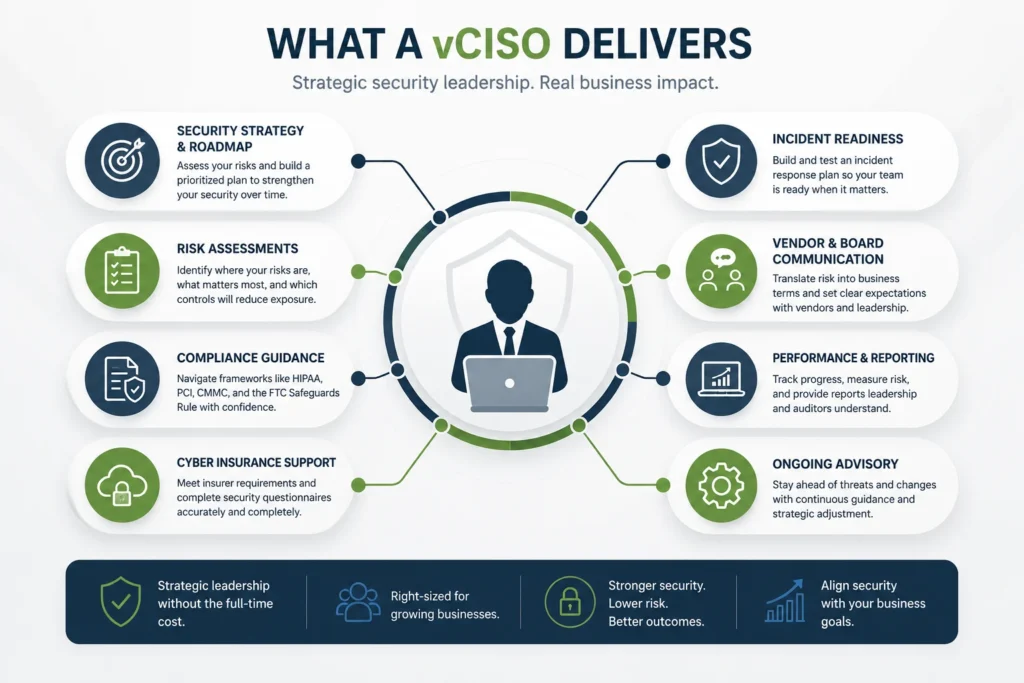
Security strategy and roadmap. A vCISO assesses your current security posture, identifies your biggest risks, and builds a prioritized plan to close the gaps over time rather than reacting to each incident. This can include aligning the organization’s security program with the NIST Cybersecurity Framework (CSF) 2.0, which provides a framework for managing and communicating cybersecurity risk.
A virtual CISO fills the leadership gap between your day-to-day IT support and the strategic security decisions your business needs to make. The role focuses on direction and accountability, not just fixing tickets.
Security strategy and roadmap. A vCISO assesses your current security posture, identifies your biggest risks, and builds a prioritized plan to close the gaps over time rather than reacting to each incident.
Risk assessments. They evaluate where sensitive data lives, how it could be exposed, and what controls belong in place, then document it in a way leadership and auditors can understand.
Compliance guidance. A vCISO helps you meet the frameworks that apply to your business, from the FTC Safeguards Rule to HIPAA, PCI, or CMMC, and prepares the documentation those frameworks require.
Cyber insurance support. Insurers now expect specific controls before they will cover you. A vCISO helps you meet those requirements and answer the security questionnaires accurately.
Incident readiness. They build and test your incident response plan so that if something goes wrong, your team knows exactly what to do.
Vendor and board communication. A vCISO translates security risk into business terms for your leadership and board, and holds your vendors to the right security expectations.
Signs your business needs a vCISO
Most businesses do not need a full-time CISO, but many have outgrown having no security leader at all. A few signals mean it is time to consider a vCISO.
You have compliance or cyber insurance pressure. If a regulation, a client, or an insurer is asking how you manage security and no one owns the answer, you need security leadership.
Your IT team keeps the lights on but does not set strategy. Great help desk and infrastructure support is not the same as someone deciding what risks to address first.
You are growing or handling more sensitive data. More employees, more clients, and more data mean more risk that needs a plan.
A client or partner is asking about your security program. Enterprise customers increasingly require their vendors to demonstrate real security governance.
vCISO vs full-time CISO vs managed IT
These three roles are often confused, so it helps to separate them. A full-time CISO is a senior executive dedicated to your business, which delivers deep focus but carries a large salary that most small and mid-size companies cannot justify. Managed IT keeps your technology running and secure day to day, but it is not the same as executive security strategy. A vCISO sits between them, providing the strategic security leadership of a CISO on a fractional basis, often alongside a managed IT or co-managed IT engagement that handles the hands-on work. For most growing businesses, the vCISO plus managed IT combination delivers both leadership and execution at a fraction of the cost of a full-time hire.
How much does a vCISO cost?
Virtual CISO services are usually priced as a fixed monthly retainer or a scoped project, which makes the cost far more predictable and affordable than a full-time executive salary. What you pay depends on the size of your business, the sensitivity of your data, and the compliance frameworks you fall under. Because the engagement is scoped to what you actually need, you get senior security leadership without paying for a full-time seat. Ask any provider for a clear scope tied to your risks and compliance obligations.
What to look for in a vCISO provider
Virtual CISO offerings vary widely, so it helps to know what separates a strong provider from a title on an invoice.
Real security leadership, not just reports. A good vCISO drives decisions and a roadmap, rather than handing you a scan and disappearing.
Compliance experience that fits you. Ask whether they have guided businesses through the specific frameworks you face, such as the FTC Safeguards Rule, HIPAA, PCI, or CMMC.
A link to hands-on execution. Strategy only helps if it gets implemented, so a vCISO who works alongside a managed IT or co-managed IT team turns the plan into action.
Clear, business-level communication. Your vCISO should explain risk in terms your leadership and board understand, not just technical findings.
Defined scope and deliverables. Look for a clear statement of what the engagement includes, how often you meet, and what you receive, so the value is measurable.
How BSGtech delivers vCISO services in Chicago
BSGtech provides virtual CISO services for businesses across Chicago and the surrounding suburbs, often alongside our managed IT and cybersecurity engagements. Our team gives your business a security leader who assesses your risks, builds a practical roadmap, guides you through compliance and cyber insurance requirements, and communicates clearly with your leadership. You get the strategic direction of a seasoned security executive without the full-time cost. Every engagement starts with a free security assessment.
Frequently Asked Questions
What is a virtual CISO?
A virtual CISO, or vCISO, is an experienced security leader who directs your cybersecurity strategy on a part-time or outsourced basis. A vCISO delivers risk assessments, security planning, compliance guidance, and incident readiness for a predictable fee, giving a growing business the leadership of a Chief Information Security Officer without the full-time cost.
How much does a vCISO cost?
Virtual CISO services are usually priced as a fixed monthly retainer or a scoped project, which is far more affordable than a full-time CISO salary. The cost depends on your business size, data sensitivity, and compliance requirements. Because the engagement is scoped to your needs, you pay only for the leadership your business actually requires.
What is the difference between a vCISO and managed IT?
Managed IT keeps your technology running and secure day to day through monitoring, support, and maintenance. A vCISO provides strategic security leadership, deciding which risks to prioritize, guiding compliance, and building your security roadmap. Many businesses use both together, with the vCISO setting direction and the managed IT team executing.
Does my small business really need a vCISO?
Many small and mid-size businesses need security leadership even if they do not need a full-time CISO. If you face compliance requirements, cyber insurance questionnaires, or client security demands, or if you handle sensitive data with no one owning security strategy, a vCISO fills that gap affordably.
What does a vCISO do for cyber insurance?
A vCISO helps you meet the security controls insurers now require before they will offer or renew coverage, such as multi-factor authentication, backups, and incident response planning. They also help you answer insurer security questionnaires accurately, which reduces the risk of a denied claim after an incident.

Michael Kahn is the founder and president of BSGtech, which has provided managed IT, cybersecurity, and backup services to Chicagoland businesses since 2009. He writes about technology in plain terms for owners who don't have IT staff in house. Read more about the author.
?%20A%20Guide%20for%20Growing%20Businesses)